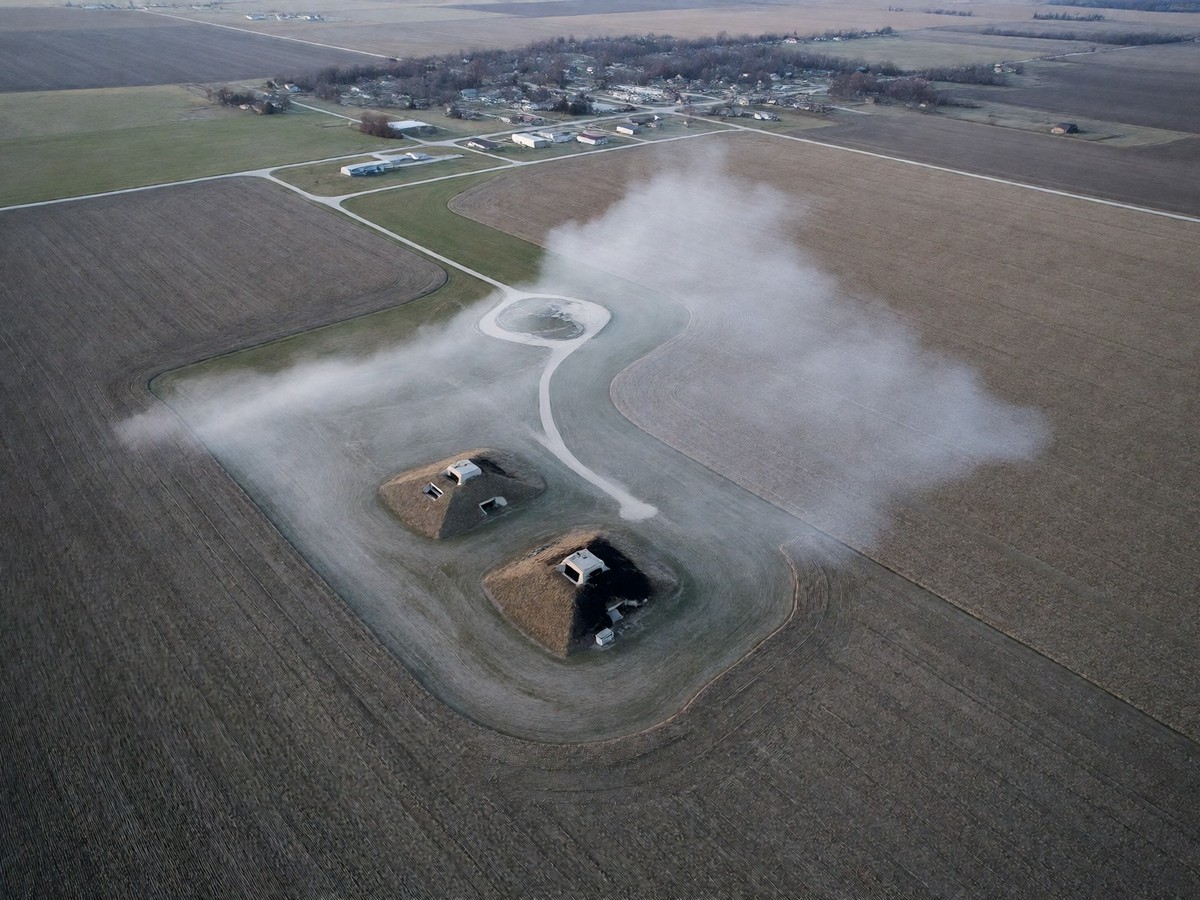
Middletown residents face chemical plume
At about 9 am CT on Wednesday, the Army detonated 68 barrels containing 9,700 pounds (4.4 tons) of degraded lead azide at the Iowa Army Ammunition Plant in Middletown. This detonation prevented a spontaneous unmitigated explosion of the crystallized, highly unstable compound. The simultaneous detonation of the two earth-covered containers sent gray-white clouds over southeastern Iowa. A KWQC journalist standing in a crop field at a reportedly safe distance said he felt the shockwave roll through the field and wore a mask for the rest of the live broadcast. Residents living within 5 miles of the facility evacuated, while people farther out sheltered in place, closed windows and doors tightly, turned off fans, and set indoor air systems to recirculate to avoid the incoming plume. Middletown, a small town of fewer than 400 people, faced the immediate impact of the blast. This massive, uncontrolled release of a neurotoxin from the two earth-covered containers remains a serious threat to the area.
Environmental fallout and health risks
Lead acts as a neurotoxin that does not break down in the environment and poses significant health risks, particularly to young children and pregnant people. In the hours leading to the detonation, the Army released maps showing modeled drift and distribution of the plume.
| Detail | Measurement |
|---|---|
| Total mass of lead azide | 9,700 pounds |
| Amount of containers | 68 barrels |
| Evacuation radius | 5 miles |
| Airborne lead travel distance | 100 miles southwest |
| Dust deposition area | 200 square miles |
Airborne lead travels around 100 miles to the southwest of the facility, while dust deposition covers about 200 square miles in that direction. Researchers and government workers already collected air and soil samples from the area to act as baseline readings for lead levels in the aftermath and fallout of the detonation. A KWQC journalist reported seeing the plume from a crop field. The Army’s modeling of the plume’s drift and distribution shows the scale of the impact on the region. The release of an unstable neurotoxin into the atmosphere and soil is a major health concern for the surrounding region and the nearby community.