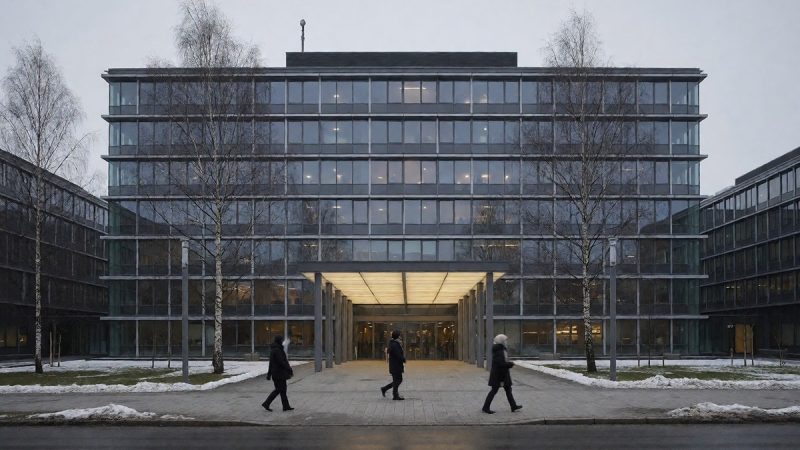
Two Flamingo missiles struck the Progress Rocket and Space Centre in Samara on 15 August, destroying a "clean room" where motherboards for Soyuz-2 rockets were assembled. The attack targeted infrastructure that launches Russia’s Rassvet satellite system, a network being rapidly deployed after Moscow was shut out of Starlink earlier this year. This strike followed Ukrainian attacks on other Roscosmos sites, including the Korolyov complex north of Moscow and a radio telescope in Crimea. Access to space has become essential for balancing the war, as drones and battlefield sensors rely heavily on satellite support. The conflict now extends into orbital domains, forcing both sides to develop countermeasures against threats like the Oreshnik ballistic missile, which deploys warheads from near space.
A sovereign orbit
Ukraine and Denmark’s GomSpace successfully launched the Obria Nano last month, marking the first test satellite for an independent Ukrainian communications network. Kyiv envisions a constellation of about 245 satellites to reduce reliance on US systems, a move driven by recent disruptions to Starlink services that jeopardized military command-and-control systems. Fedir Venislavskyi, head of the state security subcommittee of Ukraine’s parliamentary defence committee, stated that the space domain is "crucial for Ukrainian forces" and that they must not be shortsighted about risks from international space. Since Russian launch sites are beyond the range of Ukraine’s longest-range missiles, Kyiv has conducted three tests of exo-atmospheric kill systems to intercept launches in near space. These tests included targeting weapons piggybacked on very high-flying aircraft. Venislavskyi admitted that funding remains a significant issue given the huge demands of the ongoing war, but he described the development of these systems as a priority.
Orbital friction and governance gaps
Russia has used aggressive tactics in space, including signal jamming, laser-dazzling of satellites, and placing "inspector" spy satellites near foreign assets. In one incident, the Russian satellite Kosmos 2612 manoeuvred aggressively toward an Iceye commercial radar satellite that provides three-dimensional terrain imaging to the Ukrainian military. Experts described this act as deliberate harassment, possibly intended to force the satellite to use fuel to change course, thereby shortening its lifespan. Troy Meink, the US Air Force secretary, admitted in September that Washington had deployed "on-orbit space control weapons," a response to reports of Russian satellites flying close to US assets. Dr Elena Grossfeld, an expert at the Swedish Defence University, noted that while space warfare was once viewed as a future concept, the current reality places it front and centre. She pointed out that Gen David Thompson said in 2021 that the US was seeing daily attacks on its satellites by Russia and China. Victoria Samson of the Secure World Foundation observed that the rapid expansion of commercial space operations has complicated governance, as treaties remain outdated and difficult to enforce. She argued that Musk’s decision to cut Starlink data speeds forced a rethink of reliance on commercial ventures, pushing countries to seek their own versions of Starlink. The militarisation of this domain continues to outpace legal frameworks, creating a volatile environment where strategic competition is increasingly overt.